Ramada Leisure Centre in Omsk
- location
- Russia, Omsk
- design
- 2013
- site area
- 7,3 ha
- total area
- 23 200 m²
- client
- A. S. Popov Radio Plant
- architects
- Anton Nadtochiy, Vera Butko, Andrey Sizyuk, Alexander Akunets, Yuri Frolov, Alexander Malygin
The former Voskhod preventive care centre occupies a position of rare potential within the urban structure of Omsk — on the route between the airport and the city centre, on the bank of the Irtysh River, with panoramic views towards the historic part of the city and two neighbouring parks. The site has a pronounced landscape and cultural value: it lies within the territory of the Omsk Site archaeological monument — a complex of ancient settlements, burial grounds, campsites and workshops that developed over more than seven millennia, from the 6th millennium BC to the 13th century AD. Discovered in 1927, this archaeological layer becomes an important context for the project, giving depth to the place and informing its future identity.
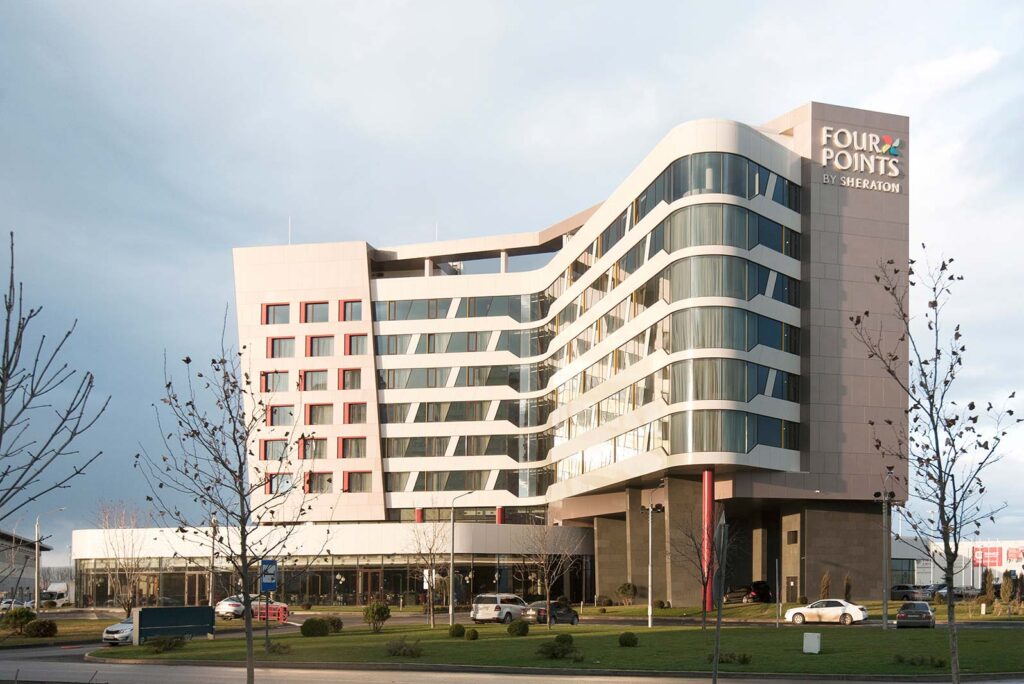
The building, constructed in the early 1980s for employees of the A. S. Popov Radio Plant, receives a new programme and market positioning: after reconstruction, it is to become a four-star hotel — a fully fledged hospitality complex for business travel, urban tourism and recreational scenarios. The project works with the existing infrastructure, unlocking its development potential: the former sports and wellness block is transformed into an extensive spa area, while the underground level acquires an independent event function — a large nightclub with a separate entrance, designed as an expressive architectural accent in the form of an inverted copper bowl.
The reconstruction is based on a careful attitude towards the original building and its architectural logic. During the design process, the architects communicated with the author of the 1980s project, discussing possible scenarios for transforming the building. This dialogue made it possible to preserve continuity with the original architectural concept while adapting the complex to the contemporary requirements of a hotel product.
In line with the client’s objectives, the project increases the total area of the complex through the extension of the existing wing and the construction of a new volume. The architectural image receives a more plastic, softer and more contemporary envelope, while the colour palette becomes warmer and closer to the natural and archaeological context of the site. The first two floors are clad in textured dark-brown concrete tiles, forming a stable, material base for the building. Above, the facade transitions into aluminium panels: white in the new part of the complex, and yellowish ochre in the reconstructed volume. This solution helps visually connect the different stages in the building’s development while emphasising the structure of the renewed hotel complex.
A separate group of design solutions relates to the room stock. The planning grid of the former preventive care centre was adapted to contemporary comfort standards: every three existing rooms were combined and reconfigured into two more spacious rooms. As a result, the complex comprises 201 rooms, with just over a third of the room stock located in the historic part of the building. This distribution makes it possible to preserve a significant share of the existing volume while bringing the hotel function to a qualitatively new level.
The interior concept develops the theme of place through reference to the archaeological heritage of the Omsk Site. A display area for artefacts is planned in the central lobby, giving the hotel’s public spaces a cultural dimension and turning them into an entry point into the local narrative. The hotel becomes part of the city’s history: a piece of Soviet recreational infrastructure is transformed into a contemporary hotel, where the development programme, architectural reconstruction, landscape setting and archaeological memory together form a coherent image of a new urban address.