Viewpolis: Development Concept for the Site on Shenogina Street
- location
- Russia, Moscow
- design
- 2016
- site area
- 14,89 ha
- total residential area
- 561 500 m²
- landscaping and public realm area
- 70 248 m²
- school area
- 28 188 m²
- kindergarten area
- 11 400 m²
- commercial floor area
- 23 411 m²
- underground car park area
- 133 524 m²
- client
- FSK Leader
- architects
- Anton Nadtochiy, Vera Butko, Nikolay Zaytsev, Polina Yavna, Maria Shuklina, Alexandra Tretyakova, Ekaterina Zvereva, Evgeny Kutay, Ivan Khripkov, Sergey Ryauzov, Petr Alimov, Ilya Zhukov, Vadim Topolev, Olga Romanova, Nikolay Filatov, Pavel Volkov, Ekaterina Polyakova
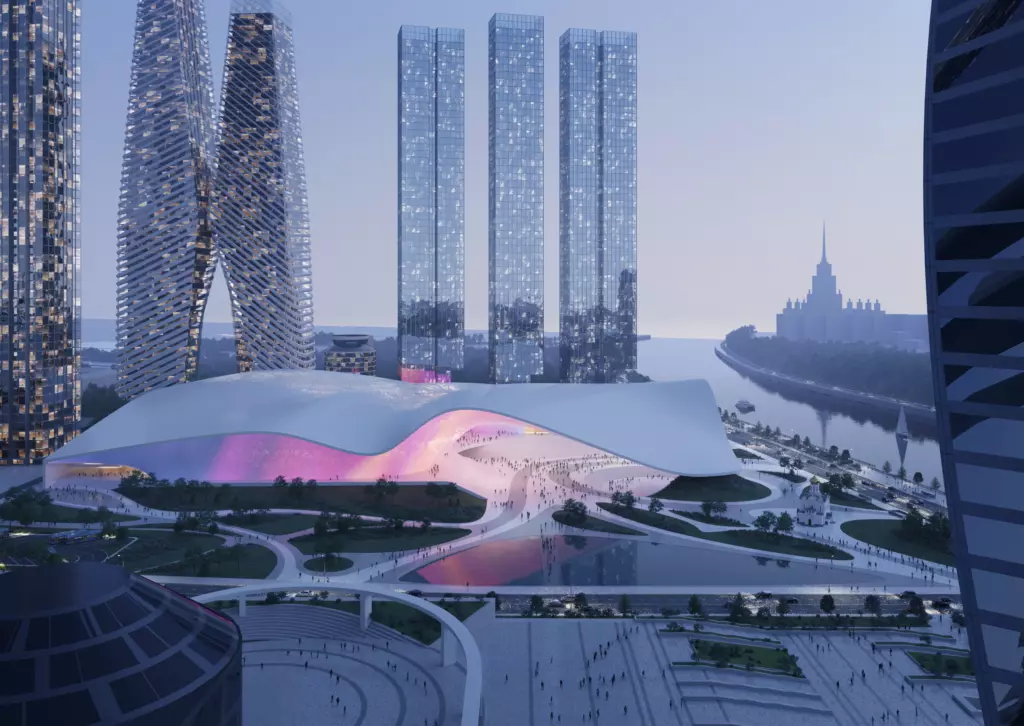
This site called for particularly high-quality and expressive architectural and planning solutions, as it is located on the bank of the Moscow River, at the heart of the перспективно developing Bolshoy City area.
Among its key advantages are its proximity to Zvenigorodskoye Highway and the Third Ring Road, as well as the rapidly developing street and road network. In particular, the authors of the project proposed extending 1st Silikatny Proezd and connecting the Karamshevskaya and Shelepikhinskaya embankments, thereby ensuring convenient access and entry points directly into the district. The area’s transport connectivity with the city will also be significantly improved by a number of measures planned by the city: a new bridge will be built nearby, and a new metro station will appear directly on the boundary of the site. In addition, the possibility of converting the former industrial pier into a passenger pier, as highlighted by the architects, would make the territory accessible by river transport along the Krylatskoye–International Exhibition route. Today, this industrial site remains cut off from the city, but it is set to become one of Moscow’s most attractive new districts.
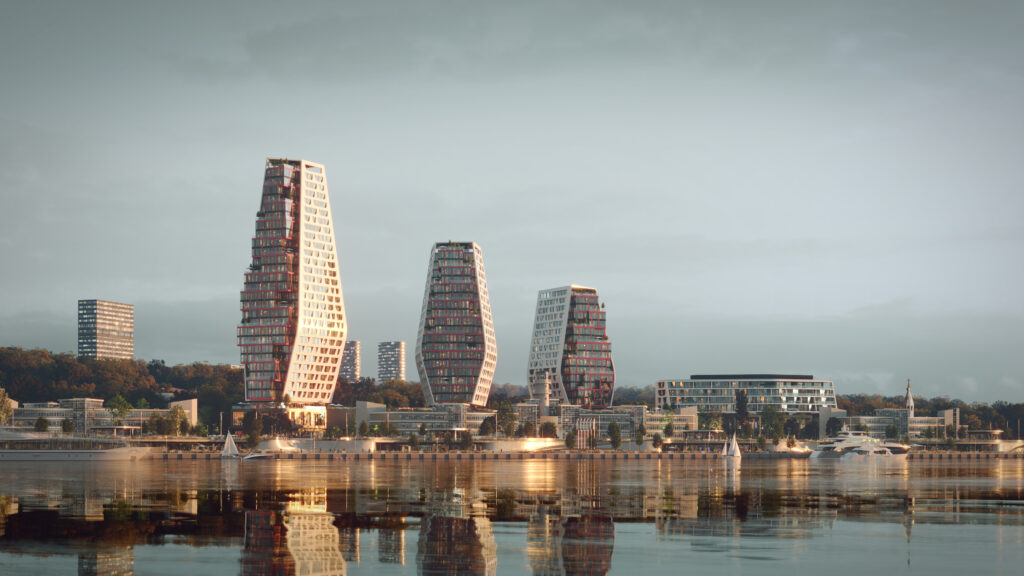
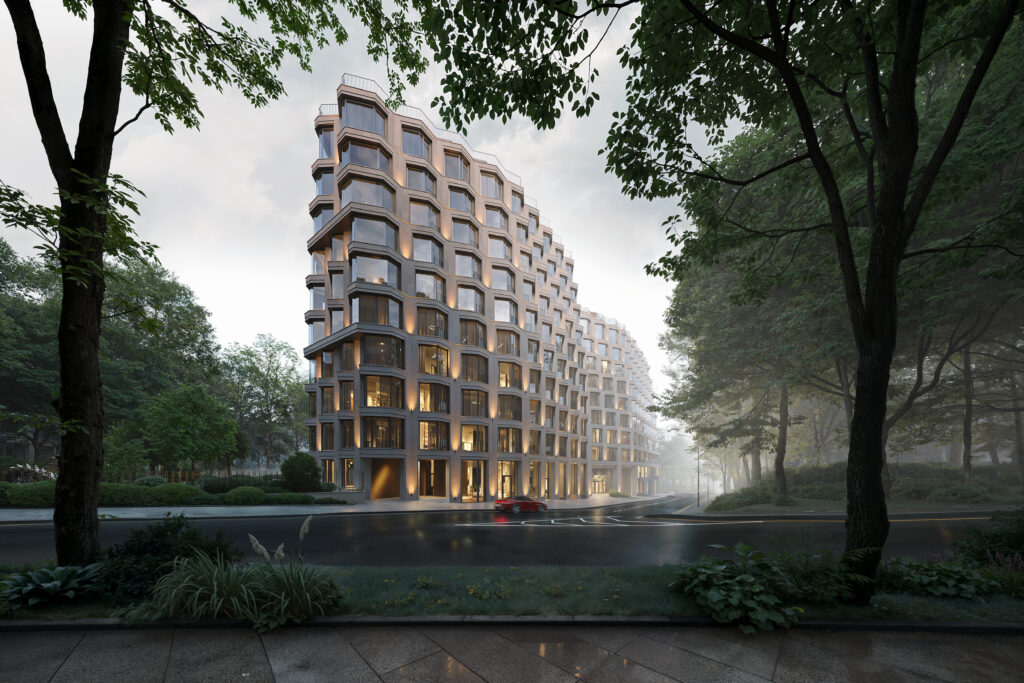
The central idea of the project is to create the greatest possible visual and spatial diversity across the district while articulating its connection to the natural setting of the Moscow River. At the heart of the picturesque planning structure lies a branching pedestrian boulevard. It links the main entrances to the district with the embankment and the riverbank, while also establishing key visual axes. Development in the northern part of the site creates dense and насыщенные urban spaces formed by perimeter blocks, with building heights stepping down towards the river and the boulevard, while the southern part is conceived as a park and riverside zone with freestanding buildings.
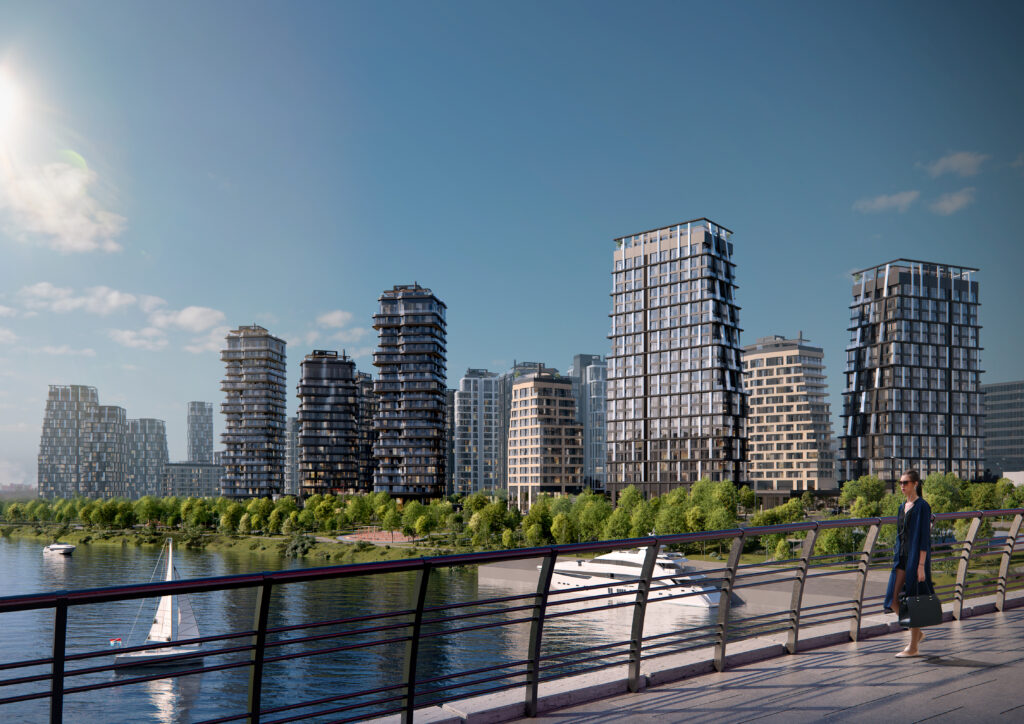
This reduction in height towards the river also opens up views for apartments in the deeper development lines. River panoramas are available throughout the site. Every apartment enjoys a view of the river, regardless of its position within the development. The dominant feature and symbol of the new district is a tower on the embankment. It becomes part of the sequence of high-rise elements shaping the image of the Moscow River. Given its surroundings, a height of 150 metres is not excessive for such a building. In this way, ATRIUM’s architects succeeded in combining within a single project the modernist urban concept of the city-park with the traditional urban block structure, creating a unique natural-urban environment.
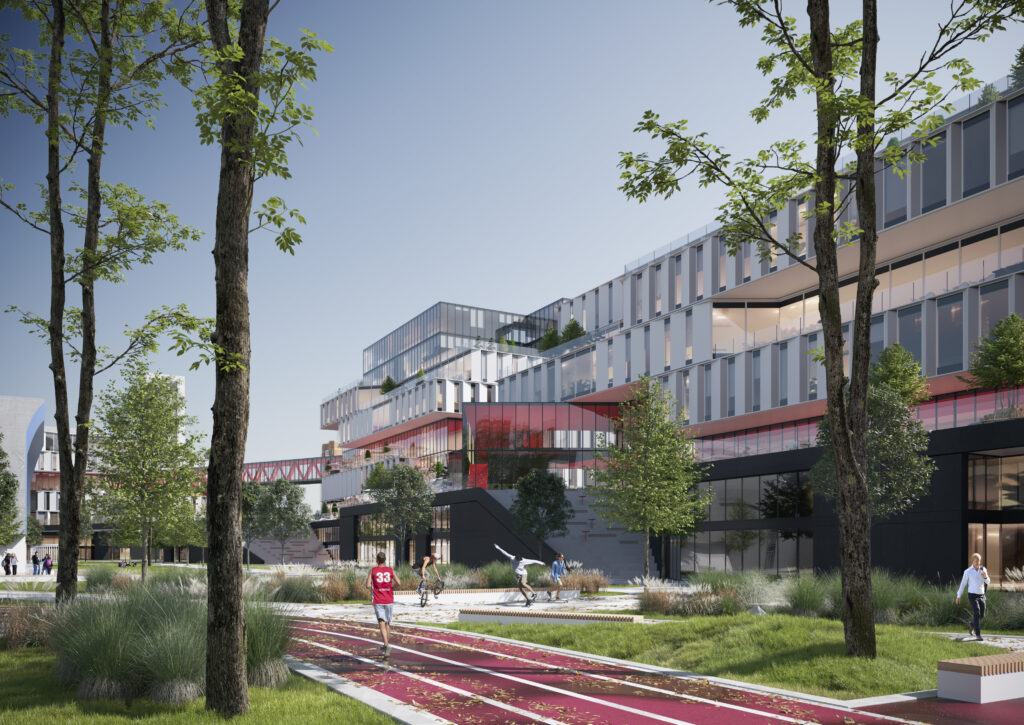
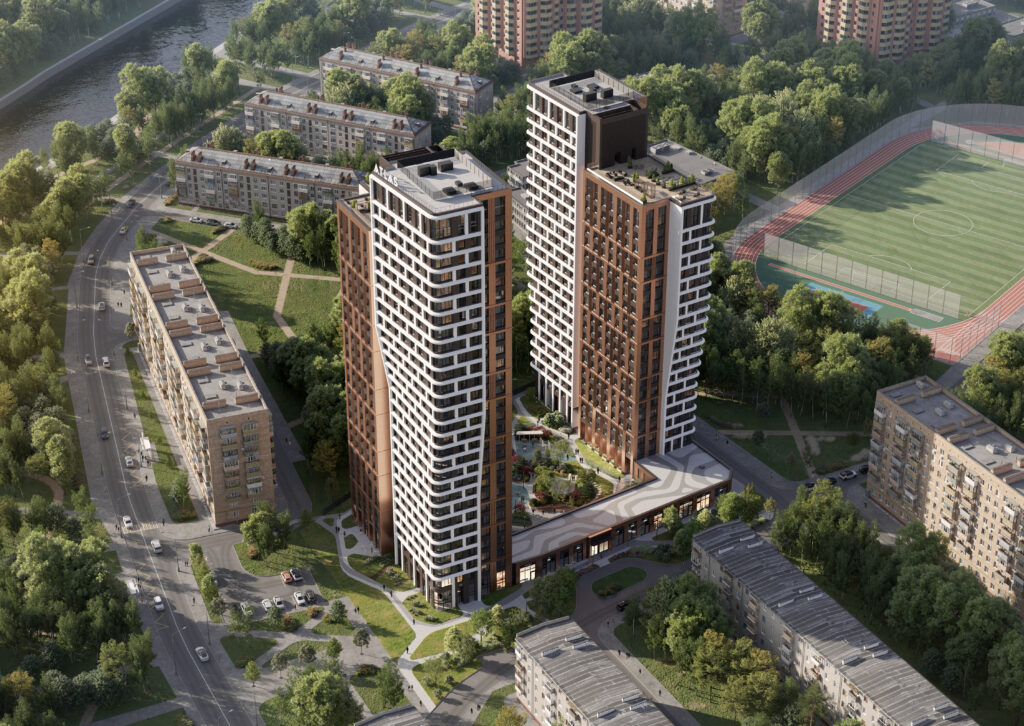
The proportions of the blocks — 110 by 80 metres — are calibrated in accordance with long-established international practice. The project fully implements the concept of car-free courtyards. Taking advantage of the topographical difference across the site, pedestrian and vehicular movement are separated. Vehicular access is organised at the lower level, with entry into the underground parking, while the courtyards are placed above on an elevated stylobate. Pedestrian movement is designed to accommodate a variety of scenarios and is arranged across several levels, connected by pedestrian bridges. There is no parking beneath the boulevard, making it possible to plant large trees and create a полноценная natural environment with landscape elements and a rich programme of uses.
The boulevard is also envisaged as an active landscape element incorporating water features, including an artificial stream fed by the Tarakanovka River, which runs close to the boundary of the site. This could become one of the first examples of implementing the concept of uncovering small rivers, an approach that forms part of the city’s wider strategy to enhance the role of the Moscow River.
The district incorporates commercial functions of various scales, from a shopping centre and offices at the entrance to the quarter to small local shops and services at ground-floor level and within the stylobates along the boulevard and embankment. Particular attention is given to social infrastructure. Four kindergartens are distributed across the site. Three of them are integrated or attached facilities, each accommodating 150 children, while a fourth, designed for 310 children, is combined with a new school for 1,700 students.
idea


drawings